Feb 05, 2026
A Pneumatic Muffler is designed to release compressed air quietly, yet many users notice that the noise level increases after several months of operation. This change often surprises equipment engineers and end users because the air circuit itself seems normal. In real factories, Air Muffler performance is affected by contamination, pressure fluctuation, and internal structural aging. Understanding these mechanisms helps distributors and maintenance teams choose the right product and service cycle instead of simply replacing parts blindly.
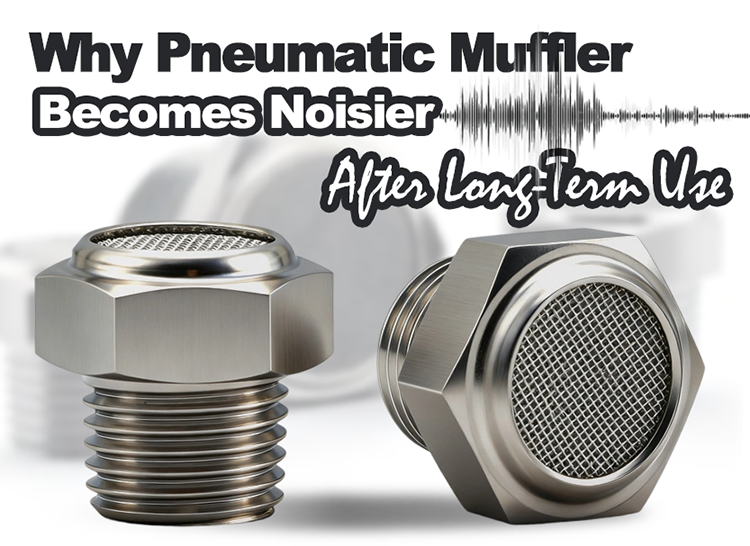
Most Pneumatic Silencer products rely on porous bronze, sintered plastic, or stainless elements to diffuse exhaust air. During operation, oil mist from lubricators and fine dust from the workshop gradually block these micro holes. Once the flow path becomes narrow, back pressure rises and the exhaust jet becomes sharp, which directly increases noise. This process is slow and invisible, so the Noise Reduction Muffler may appear intact from outside while the inner structure has already lost its function.
Even without heavy dirt, the material inside a Pneumatic Exhaust Silencer will change under long-term high-speed airflow. Repeated pressure pulses compress the porous media, and some particles fuse together under temperature. The effective surface area becomes smaller, making the airflow less uniform. Engineers often find that two identical machines produce different sound levels simply because one muffler has been used longer. Regular inspection is the only reliable way to keep stable noise control.
Compressed air quality plays a decisive role. Excessive oil forms sticky layers inside the Air Muffler, while water causes corrosion in metal types. Outdoor equipment suffers from humidity and chemical vapors. These factors not only increase noise but also shorten the life of downstream valves and cylinders. Installing a filter-regulator unit before the exhaust line protects both the Pneumatic Muffler and the whole system.
| Cause | Result on muffler | Recommended action |
|---|---|---|
| Oil mist | Sticky blockage | Use oil-resistant type, clean periodically |
| Dust particles | Pore clogging | Add upstream filtration |
| Water vapor | Corrosion, rust | Install dryer or stainless model |
| High pressure pulse | Media compression | Select larger size |
| Chemical gas | Material aging | Choose special material |
Modern designs provide options beyond disposable parts. Cleanable Pneumatic Silencer with detachable elements allows technicians to wash the core and restore airflow. For heavy-duty lines, stainless steel models resist corrosion and keep structure stable. Distributors who recommend the correct type help customers reduce downtime and spare cost. Instead of changing a Noise Reduction Muffler every few months, planned maintenance extends the interval dramatically.
When choosing a new Pneumatic Exhaust Silencer, consider not only thread size but also air consumption and environment. Oversized models lower back pressure and remain quieter for longer periods. Machines with frequent exhaust should use metal bodies, while light automation can use plastic types for economy. Providing this advice strengthens trust between suppliers and end users, turning a simple accessory into a professional solution.
A noisier muffler is a signal rather than a random failure. By controlling air quality, checking contamination, and adopting maintainable products, factories can keep the Pneumatic Muffler working as quietly as the first day and protect the reliability of the entire pneumatic system.
(FK9026)
 Pneumatic Clamping Module Design in Packaging Machinery
 Pneumatic Fittings Replacement Cycle: How Often Should You Change Pneumatic Fittings
 Pneumatic Pusher Module Design in Pneumatic Packaging Machines
 Vacuum Filter and Response Time: Does Filtration Slow Down Vacuum Systems
 Metal Seated Pneumatic Ball Valve: When Is Metal Sealing Required?

Whatsapp QR:

WeChat QR:

Tell us about your application requirements. Our engineers will review your project and provide practical feedback within 1–2 working days.

Fescolo is the specialized custom pneumatic cylinder brand operated by Ningbo Fokca Automation Co., Ltd.
Looking for standard pneumatic and automation components?
Visit Fokca
© 2026 Ningbo Fokca Automation Co., Ltd. All Rights Reserved. Sitemap