Mar 13, 2025
A magnetic pneumatic cylinder is a pneumatic cylinder with a permanent magnet integrated into the piston. As the piston moves inside the barrel, an externally mounted magnetic sensor can detect when the magnet enters its sensing range. This gives the machine a simple way to confirm piston position without placing a mechanical switch inside the pressure chamber.
The important point is that the magnet does not drive the cylinder. Compressed air still produces the force and motion in the same way as in a conventional pneumatic cylinder. The magnetic system adds position detection so a PLC or other control system can use the cylinder movement as part of an automated sequence.
In a typical double-acting cylinder, a directional valve alternately supplies compressed air to the two sides of the piston. The pressure difference moves the piston and piston rod. When the piston magnet passes beneath a sensor mounted on the outside of the cylinder, the magnetic field changes the sensor output.
That electrical signal can be used to confirm that the cylinder has reached an extended position, retracted position or another selected sensing point. The sensor is normally adjusted along the cylinder body or sensor groove until it switches reliably at the required position.
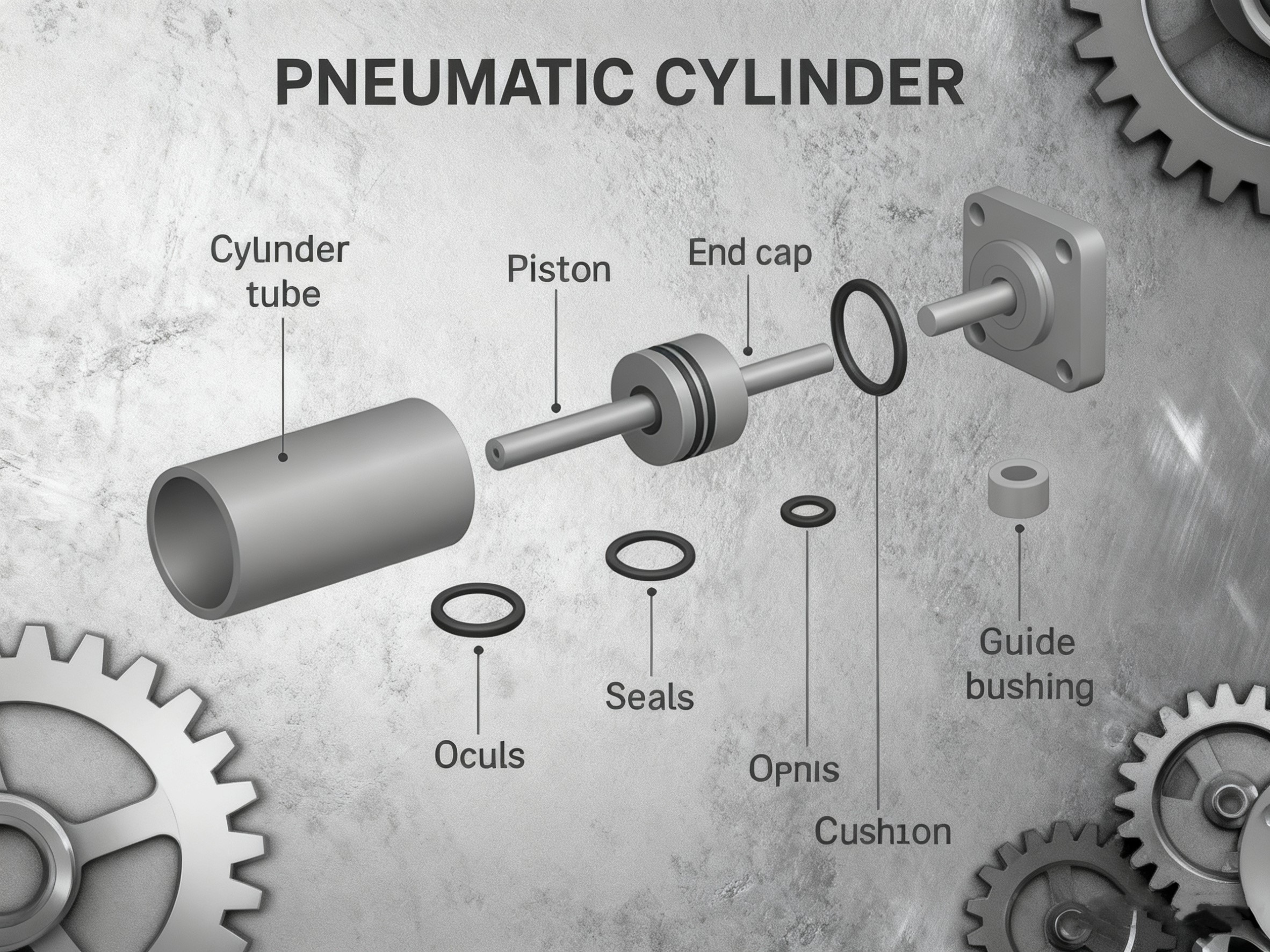
The pneumatic components remain familiar: barrel, piston, piston rod, seals, end caps, ports and, where applicable, cushioning components. The main additional feature is a magnet or magnetic ring associated with the piston. The cylinder body must also allow the magnetic field to reach the external sensing location with sufficient strength for the intended sensor system.
For a broader explanation of the mechanical components, see Exploring the Critical Parts of a Pneumatic Cylinder.
“Magnetic switch” is often used as a general term, but cylinders can be paired with different sensing technologies. Two common categories are reed switches and solid-state electronic sensors.
Sensor type | How it works | Typical considerations |
Reed switch | A magnetic field actuates sealed mechanical contacts | Simple; check switching load, response, hysteresis and expected cycle life |
Electronic / solid-state sensor | A semiconductor sensing element responds to the magnetic field | No mechanical contact; may offer faster switching, indicator LEDs or additional output options |
Neither type is universally better. The correct choice depends on the PLC input, supply voltage, output configuration, switching current, cable connection, required response and environmental conditions. Always check the cylinder and sensor manufacturer's compatibility data rather than assuming that any magnetic switch will work with any cylinder.
Most standard magnetic cylinder sensors are used as discrete position switches. They tell the control system that the piston has entered a sensing zone; they do not normally provide a continuous, high-resolution measurement of piston position across the full stroke.
This distinction matters. A cylinder with a magnetic piston is useful for sequence confirmation, interlocking and end-position feedback, but it should not automatically be described as a precision positioning actuator. If continuous position measurement or closed-loop positioning is required, a different sensing arrangement or actuator system may be needed.
The main advantage is practical machine feedback. The sensor can detect piston movement through the cylinder wall without a mechanical limit switch being struck by the moving mechanism. This can simplify machine sequencing and reduce the need for exposed mechanical contact at the sensing point.
• Confirm that a clamp has reached its working position before the next machine step begins.
• Confirm that a pusher or stopper has retracted before a conveyor or transfer mechanism moves.
• Provide an interlock signal for packaging, assembly and material-handling equipment.
• Detect selected piston positions where the cylinder and sensor arrangement supports intermediate sensing.
The sensor confirms position; it does not guarantee that the external load is correctly clamped, that the required force has been reached, or that the mechanism is free from obstruction. Those conditions may require pressure sensing, force sensing or other machine feedback.
Magnetic piston sensing is common in industrial automation because many machine cycles depend on knowing whether a cylinder has completed a movement. Typical applications include packaging machines, assembly equipment, material handling, conveyors, pick-and-place mechanisms, clamping stations and automated production fixtures.
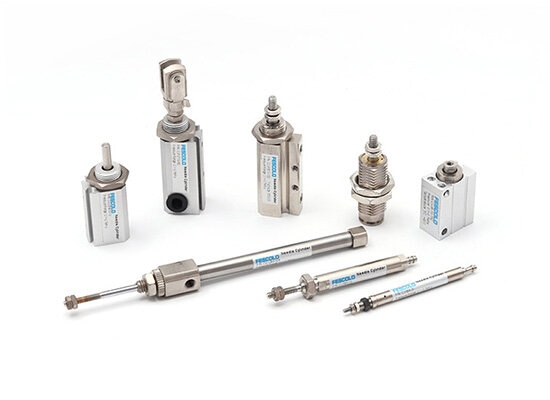
The same principle can be used across many cylinder constructions, including compact, mini, ISO-profile, guided and other special cylinders, provided the cylinder is designed for magnetic sensing and has a compatible sensor mounting method.
A magnetic sensor should be positioned where the piston magnet produces a stable switching signal over the required portion of travel. If the sensor is placed at the edge of its operating zone, vibration, tolerance variation or speed can make switching less reliable.
During commissioning, move the cylinder through the relevant position and verify the actual switch-on and switch-off points. For end-position confirmation, leave appropriate mechanical and sensing margin rather than treating the first point at which an indicator LED turns on as an exact dimensional reference.
Issue | Why it matters |
Incorrect sensor type or wiring | Output may not match the PLC/input circuit or may not switch correctly |
Sensor mounted outside the effective sensing zone | Magnetic field may be too weak or switching may be intermittent |
Sensor moves in its mounting groove | The detected position changes during operation |
Nearby strong magnetic fields or ferromagnetic structures | Can influence some sensing arrangements; installation guidance should be checked |
Excessive vibration or impact | Can affect mounting stability and the electrical connection |
Wrong cylinder/sensor combination | Magnet strength, geometry and sensor characteristics may not be compatible |
For normal cylinder sizing, the piston magnet is not the source of motion and is not used to calculate output force. Pneumatic force is determined primarily by the pressure acting on the effective piston area. Bore size and working pressure therefore remain central to force selection.
If force sizing is the question, see Pneumatic Air Cylinder Force Calculation. The magnetic feature should be considered separately as part of the machine's sensing and control requirements.
These two terms are easy to confuse. A conventional magnetic pneumatic cylinder usually means a cylinder with a magnet in the piston for position sensing. A magnetically coupled rodless cylinder uses magnetic attraction for a different purpose: transmitting piston motion through the cylinder wall to an external carriage without a conventional piston rod.
Both use magnets, but their functions are different. One uses magnetism mainly for sensing; the other uses magnetic coupling as part of the mechanical transmission. This distinction should be checked when reading product descriptions or specifying a custom cylinder.
Start with the cylinder as an actuator, then add the sensing requirements. Bore, stroke, force, speed, mounting and environment still determine whether the cylinder can perform the mechanical task. After that, confirm the magnetic and electrical details of the sensor system.
Cylinder / machine requirement | Sensor / control requirement |
Required force and working pressure | Number of sensing positions |
Bore and stroke | Reed or electronic sensor type |
Mounting and installation envelope | Supply voltage and output configuration |
Speed and cycle rate | PLC/input compatibility and response |
Environment and temperature | Cable/connector, protection and mounting method |
Cushioning and load behavior | Required sensing margin and repeatability |
For custom cylinder projects, Fescolo can consider sensor requirements together with the mechanical cylinder design. This is especially useful when a machine has a non-standard stroke, limited sensor installation space, special mounting geometry or a required switching location that should be reviewed before the cylinder structure is finalized.
A magnetic piston is a simple feature, but it becomes useful only when the sensor signal is designed into the machine logic correctly. The cylinder must still be sized for the load, the sensor must be compatible with the cylinder and control system, and the switching point must be verified on the actual machine.
For many industrial applications, the best use of magnetic sensing is not to make the cylinder “more precise,” but to make the machine sequence more observable: the controller can confirm that a motion has reached the expected zone before allowing the next action to proceed.
A permanent magnet is integrated into or attached to the piston so an external compatible sensor can detect the piston as it moves inside the cylinder.
No. Compressed air produces the cylinder force and motion. The magnet is normally used for position sensing.
A standard cylinder switch normally provides discrete on/off position detection within a sensing zone. It should not be assumed to provide continuous high-resolution position measurement.
Not necessarily. The cylinder needs a suitable piston magnet and a compatible sensor mounting arrangement. Cylinder construction and sensor specifications should be checked first.
A reed switch is one common type of magnetic cylinder sensor. Solid-state electronic magnetic sensors are also widely used.
Often yes, if the cylinder provides a suitable sensor mounting path and the required position falls within a stable sensing range. The actual switching position should be verified during machine commissioning.

Whatsapp QR:

WeChat QR:

Tell us about your application requirements. Our engineers will review your project and provide practical feedback within 1–2 working days.

Fescolo is the specialized custom pneumatic cylinder brand operated by Ningbo Fokca Automation Co., Ltd.
Looking for standard pneumatic and automation components?
Visit Fokca
© 2026 Ningbo Fokca Automation Co., Ltd. All Rights Reserved. Sitemap