Feb 03, 2026
In pneumatic automation, a vacuum filter is often treated as a small accessory, yet its condition directly affects system stability. When a filter becomes clogged, airflow resistance increases silently, altering how the entire vacuum circuit behaves. In pick-and-place units, packaging machines, or robotic end effectors, this change may not trigger alarms immediately, but it gradually erodes performance and reliability. Understanding the real risks behind pneumatic vacuum filter blockage helps engineers and buyers make better maintenance and selection decisions.
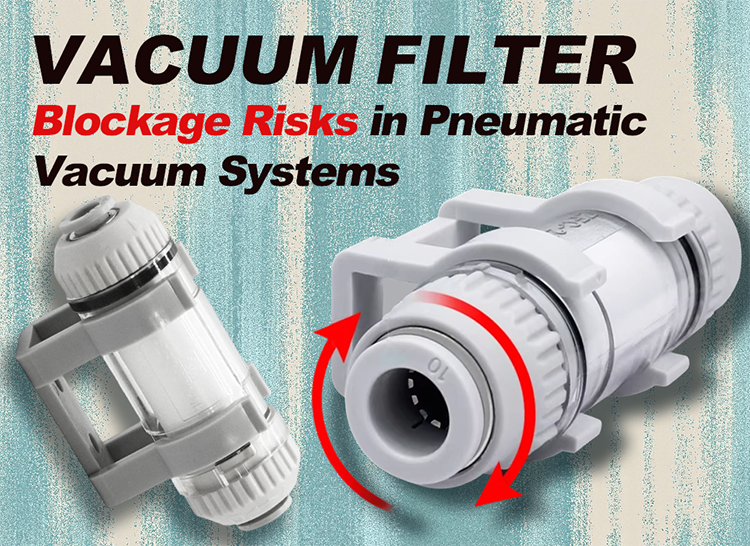
A blocked vacuum filter restricts the evacuation path between the vacuum generator and the suction cup. As dust, paper fibers, or process residues accumulate, the effective flow area decreases. This means the system needs more time to reach the target vacuum level.
In high-speed automation, even a few hundred milliseconds of delay can disrupt cycle timing. Grippers may not reach holding force before motion starts, leading to dropped parts or emergency stops.
This issue is often misdiagnosed as a weak vacuum pump, while the root cause is simply filtration resistance.
Beyond response time, blockage directly limits achievable vacuum degree. When pressure loss increases across a clogged element, the system may never reach the designed negative pressure.
This is critical in applications handling uneven or porous surfaces.
Lower vacuum level equals reduced holding force, increasing the risk of slippage during acceleration or vertical lifting. In packaging and electronics assembly, this can translate into damaged products and unplanned downtime.
For users familiar with smc vacuum filter designs, this behavior is well documented: insufficient maintenance causes gradual vacuum decay rather than sudden failure.
Filter blockage does not only affect performance; it also impacts energy consumption. To compensate for airflow loss, vacuum generators or ejectors run longer and more frequently.
Over time, this leads to:
◆Higher compressed air consumption
◆Increased wear on vacuum generators
◆Unstable system tuning
From a procurement perspective, this hidden cost often exceeds the price of replacing the pneumatic vacuum filter element on schedule.
One way to mitigate blockage risk is using filters with visual contamination indicators. Compared with sealed designs, visual-type vacuum filters allow operators to assess clogging without disassembly.
| Feature | Standard Vacuum Filter | Visual Vacuum Filter |
|---|---|---|
| Contamination visibility | Not visible | Clearly visible |
| Maintenance timing | Reactive | Preventive |
| Downtime risk | Higher | Lower |
| Suitability for OEM equipment | Limited | Highly suitable |
This approach is especially useful for distributed vacuum systems where manual inspection is impractical.
Some users attempt to solve blockage by installing larger filters. While this may delay clogging, it does not eliminate contamination accumulation. Regular replacement or cleaning remains essential, particularly in dusty or fibrous environments.
A properly sized vacuum filter, replaced at defined intervals, maintains stable vacuum response and predictable system behavior. Oversizing without maintenance only postpones failure.
When selecting a pneumatic vacuum filter, consider:
◆Particle type and load in the working environment
◆Required response time of the vacuum system
◆Accessibility for maintenance
◆Availability of replacement elements
For modular automation lines, combining a visual filter with standardized cartridges simplifies spare parts management and reduces operator error.
If you are evaluating compatible alternatives to smc vacuum filter solutions, ensure filtration accuracy and flow capacity are matched to your vacuum generator, not just connection size.
(FK9026)
 Pneumatic Clamping Module Design in Packaging Machinery
 Pneumatic Fittings Replacement Cycle: How Often Should You Change Pneumatic Fittings
 Pneumatic Pusher Module Design in Pneumatic Packaging Machines
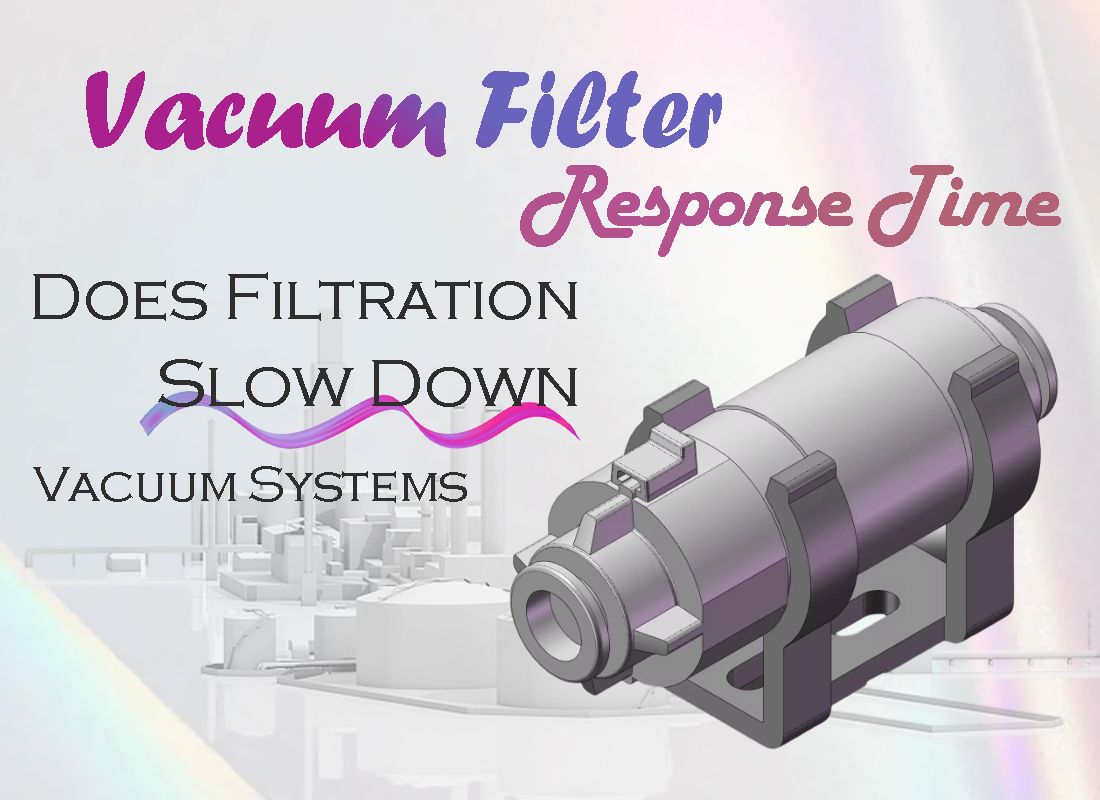 Vacuum Filter and Response Time: Does Filtration Slow Down Vacuum Systems
 Metal Seated Pneumatic Ball Valve: When Is Metal Sealing Required?

Whatsapp QR:

WeChat QR:

Tell us about your application requirements. Our engineers will review your project and provide practical feedback within 1–2 working days.

Fescolo is the specialized custom pneumatic cylinder brand operated by Ningbo Fokca Automation Co., Ltd.
Looking for standard pneumatic and automation components?
Visit Fokca
© 2026 Ningbo Fokca Automation Co., Ltd. All Rights Reserved. Sitemap