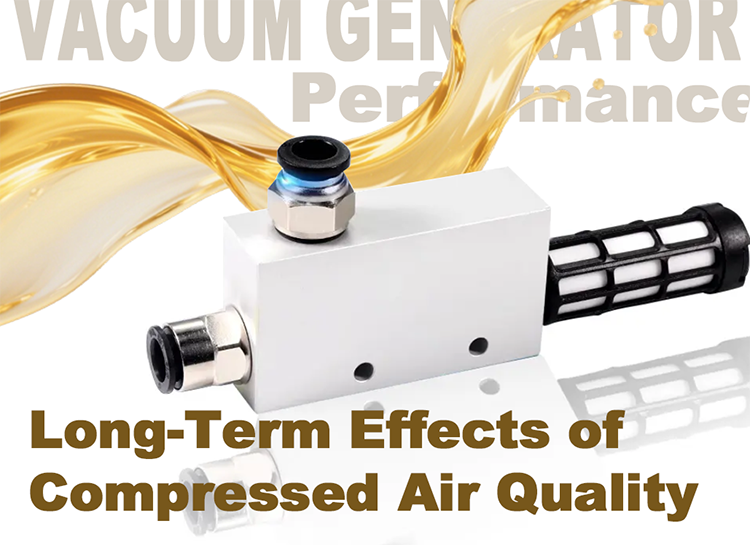
The operating stability of a vacuum generator depends heavily on the quality of the compressed air supply. In many industrial environments, compressed air contains moisture, oil mist, and particulate contaminants that gradually reduce suction efficiency and internal flow stability. Over time, poor compressed air for vacuum generator systems can cause nozzle blockage, unstable vacuum levels, and increased maintenance frequency. Maintaining clean, dry air is one of the most critical factors for ensuring long service life and consistent vacuum performance.
How Air Contamination Affects a Pneumatic Vacuum Generator
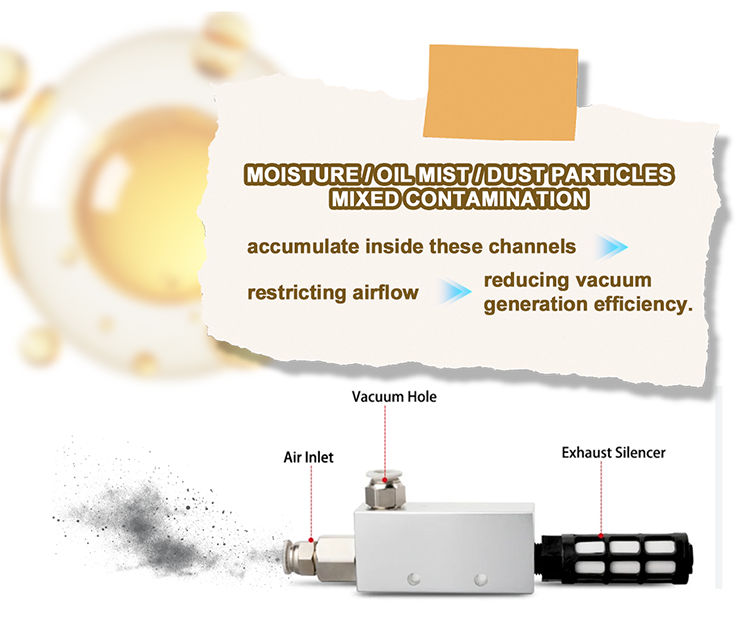
A pneumatic vacuum generator operates using precision Venturi nozzles and narrow flow passages. When contaminated air enters the system, small particles and oil droplets accumulate inside these channels, restricting airflow and reducing vacuum generation efficiency.
Moisture contamination introduces additional risks. Condensed water can cause internal corrosion or combine with dust particles to form deposits that further narrow flow passages.
Even minor contamination can significantly reduce vacuum response speed and suction stability in high-cycle automation systems.
Typical Long-Term Performance Degradation
| Air Contaminant | Internal Effect | Resulting System Problem |
|---|---|---|
| Moisture | Corrosion, water deposits | Reduced vacuum efficiency |
| Oil mist | Nozzle surface coating | Slower response and unstable suction |
| Dust particles | Passage blockage | Reduced airflow capacity |
| Mixed contamination | Sludge formation | Frequent maintenance and downtime |
Performance degradation usually occurs gradually, making it difficult to detect until suction force becomes insufficient for normal operation.
Why Proper Air Preparation Is Essential
Because the vacuum generator relies entirely on compressed air energy, air preparation directly determines operational efficiency. Without adequate treatment, compressed air systems continuously introduce contaminants into the vacuum unit, shortening maintenance intervals and increasing operating costs.
Recommended upstream protection includes:
1.Primary particulate filters
2.Coalescing filters for oil mist removal
3.Refrigerated or desiccant air dryers
4.Pressure regulators for stable supply pressure
A well-designed air preparation combination significantly extends vacuum generator service life while ensuring stable suction performance.
Recommended Air Treatment Configuration
| Component | Function | Installation Position |
|---|---|---|
| Air filter | Removes solid particles | Compressor outlet / local station |
| Air dryer | Eliminates moisture | Before distribution lines |
| Oil removal filter | Removes oil mist | Upstream of vacuum devices |
| Regulator | Stabilizes pressure | Near the vacuum unit |
For distributed automation equipment, installing local filtration units near the pneumatic vacuum generator provides additional protection against pipeline contamination.
Application Environments Requiring Enhanced Air Filtration
Certain operating environments demand stricter air treatment due to higher contamination risks:
◆Packaging lines with oil-lubricated compressors
◆High-humidity manufacturing plants
◆Outdoor automation equipment
◆Electronics assembly requiring stable vacuum gripping
◆Food processing machinery with washdown conditions
In these environments, multi-stage filtration systems ensure consistent compressed air for vacuum generator operation and reduce unexpected performance fluctuations.
Engineering Recommendation
For long-term reliability, compressed air treatment should be considered part of the vacuum system design rather than an optional accessory. Proper filtration, drying, and pressure stabilization protect the pneumatic vacuum generator, maintain suction consistency, and minimize maintenance costs across the entire automation line.
(FK9026)