Sep 30, 2026
Professional service robots are moving rapidly from trials into real commercial operations.
According to the International Federation of Robotics, global shipments of professional service robots increased by 24% to almost 250,000 units in 2025.
Transport and logistics robots formed the largest application group, showing how quickly automation is expanding through warehouses, distribution centers and material-handling operations.
This growth marks an important change: robots are no longer used only behind fixed safety fences in traditional factories. They are increasingly moving through real working environments.
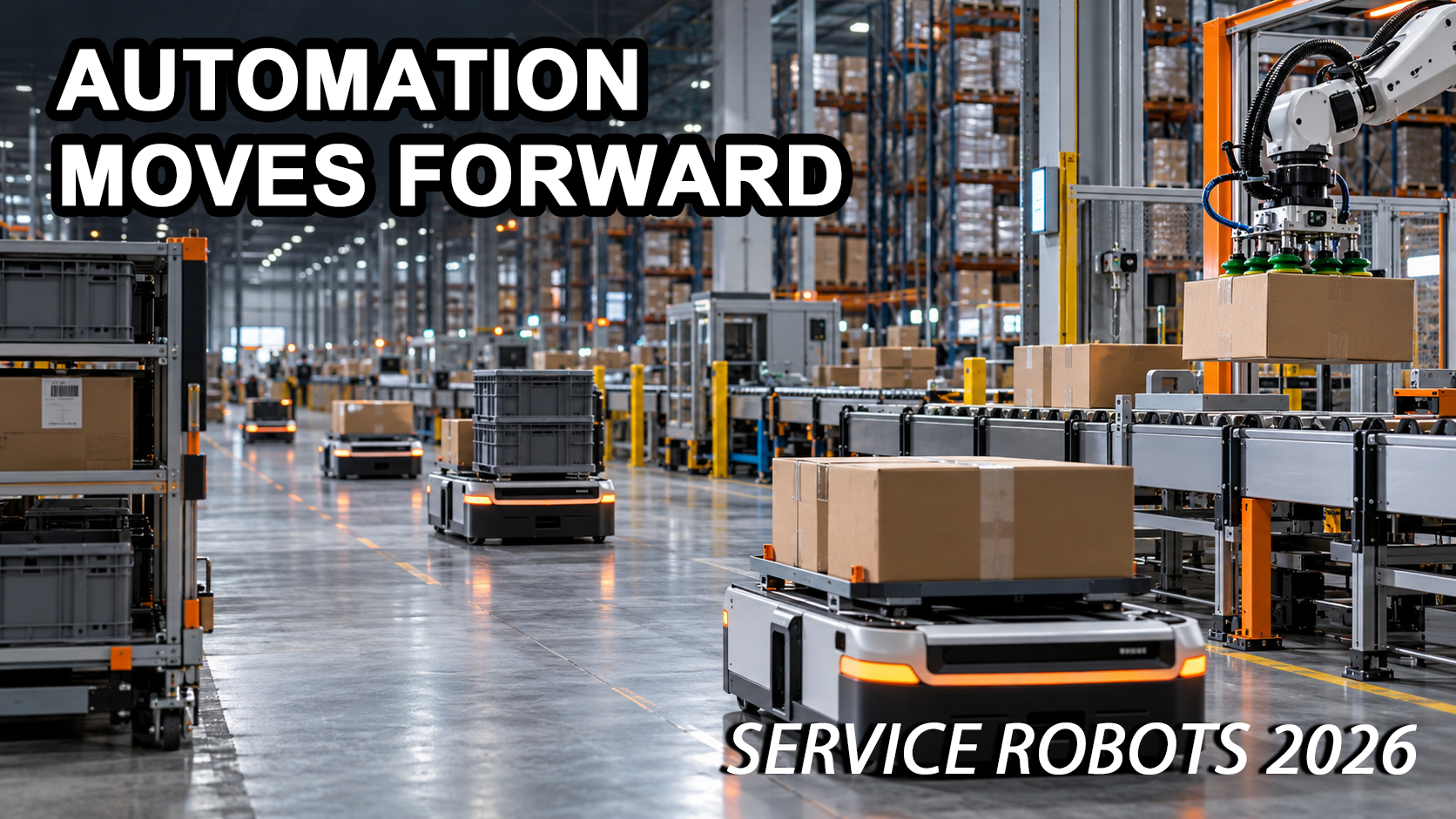
Warehouses and distribution centers must process more products while improving speed and order accuracy.
Autonomous mobile robots can transport cartons, containers and materials between storage, picking and packing areas. Robotic handling stations can then lift, sort, grip or position those items.
This combination reduces repetitive manual transport and allows employees to focus on tasks requiring greater judgment and flexibility.
Moving a robot through a warehouse is only one part of the process. The robot or automated station must also interact with different objects.
Packages vary in size, weight, material and surface condition. A handling system may therefore require vacuum gripping, mechanical gripping, clamping, lifting or controlled positioning.
Pneumatic components remain valuable in these applications because they can provide fast movement, compact construction and practical force for repeated handling operations.
Correct pressure, suitable cylinder sizing and stable movement are essential. Excessive force can damage products, while insufficient force can cause unstable handling or dropped loads.
A demonstration can run for several minutes. A commercial automation system must operate reliably through long shifts and repeated cycles.
Maintenance access, component life, energy consumption and downtime all influence whether a system delivers real value.
This makes component selection an important part of service robot and logistics equipment design. Actuators must match the load, speed, installation space, operating environment and expected cycle frequency.
The 24% increase in professional service robot shipments shows that commercial automation is gaining real momentum.
As robots enter more logistics and service applications, the demand for reliable gripping, lifting, clamping and positioning will continue to grow.
At FESCOLO, we work with equipment manufacturers to develop pneumatic cylinder solutions around actual operating conditions. Standard and customized options can support different strokes, installation dimensions, loads, speeds and working environments.
The future of service robotics will depend on intelligent navigation and control—but its daily performance will still be measured by reliable physical movement.
Source: International Federation of Robotics, “Global Sales of Professional Service Robots Surge 24%,” September 30, 2026.
 Global Professional Service Robot Shipments Rise 24%
 Five Million Industrial Robots Now Operate in Factories Worldwide
 Pneumatic Automation in 2026: Smarter, More Efficient and More Adaptable
 HANNOVER MESSE 2026: AI, Robotics and Automation
 Top Five Global Robotics and Industrial Automation Trends for 2026

Whatsapp QR:

WeChat QR:

Tell us about your application requirements. Our engineers will review your project and provide practical feedback within 1–2 working days.

Fescolo is the specialized custom pneumatic cylinder brand operated by Ningbo Fokca Automation Co., Ltd.
Looking for standard pneumatic and automation components?
Visit Fokca
© 2026 Ningbo Fokca Automation Co., Ltd. All Rights Reserved. Sitemap