Dec 25, 2024
The core purpose of calculating pneumatic cylinder force is to help Customers, manufacturers, DIY enthusiasts, researchers, etc to select the appropriate cylinder specification, ensuring customer or manufacturer get reliable operation while effectively pushing the load and maximizing cost efficiency.
As the core component of the actuator in the field of precision machinery and automation control, the air cylinder has many types, and each series of cylinders has different sizes. Do you know how to choose the most suitable size among the various cylinders? How to calculate air cylinder force according to your actual needs?What parameters and tools do you need to measure before calculating? This article will tell you everything.
Although the formulas used to calculate the output force of pneumatic cylinders and hydraulic cylinders are the same, the compressibility of compressed air, due to the difference in media, results in a larger discrepancy between the theoretical and actual values of pneumatic cylinder force compared to hydraulic cylinders. Here, we will primarily introduce the applicable calculation formulas and provide a calculation example to help you understand how to calculate pneumatic cylinder push and pull force.
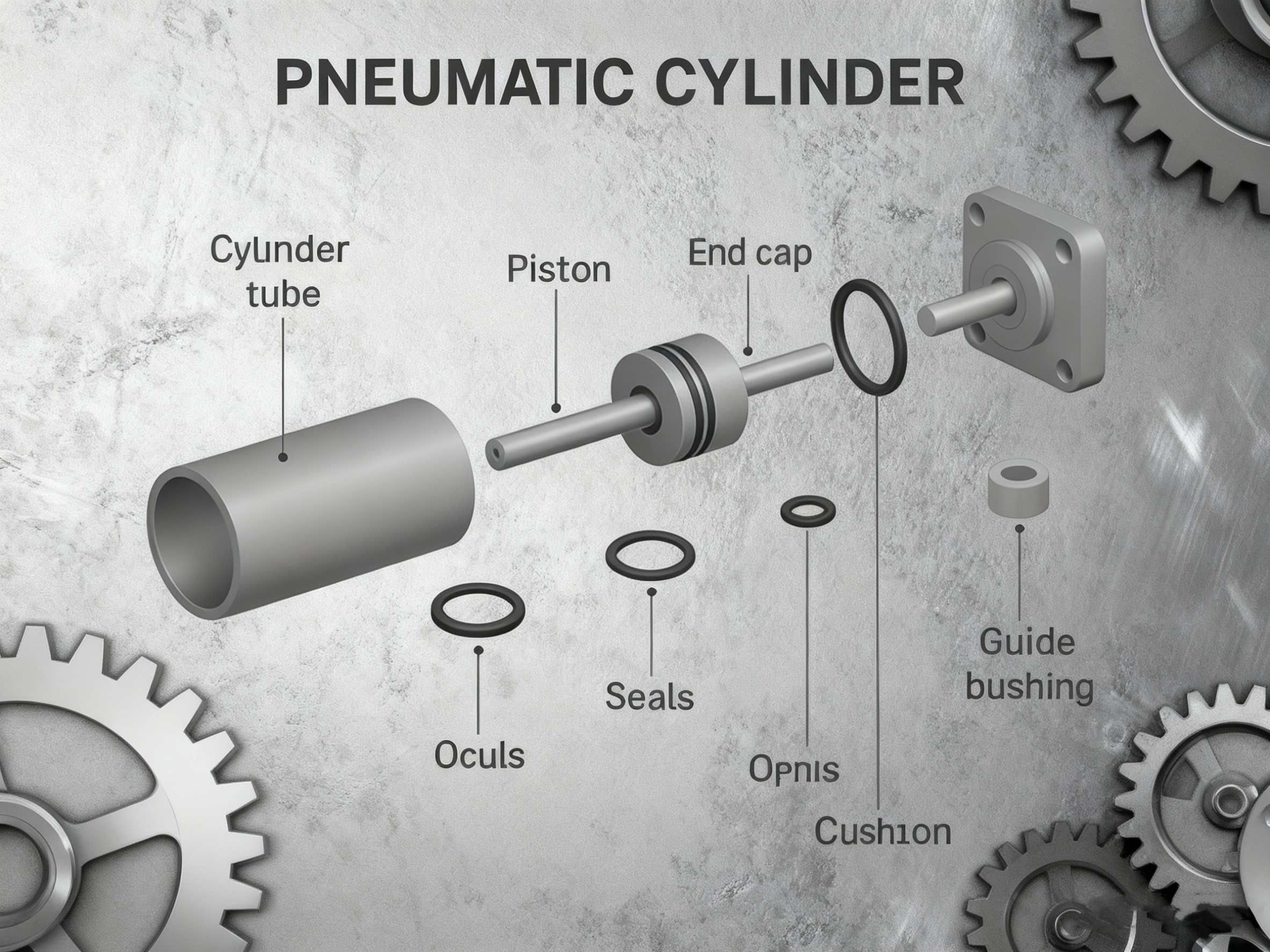
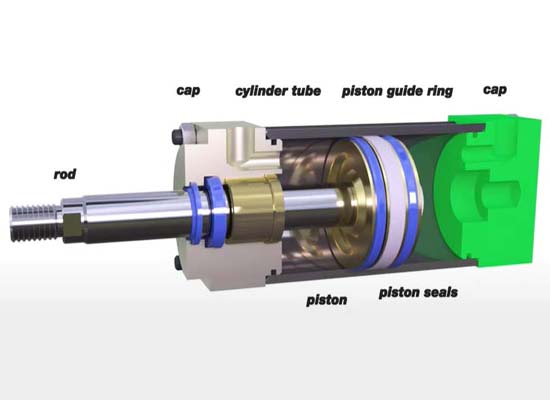
To make a correct force calculation of a pneumatic cylinder, it is essential to understand that the main moving parts is the piston rod.
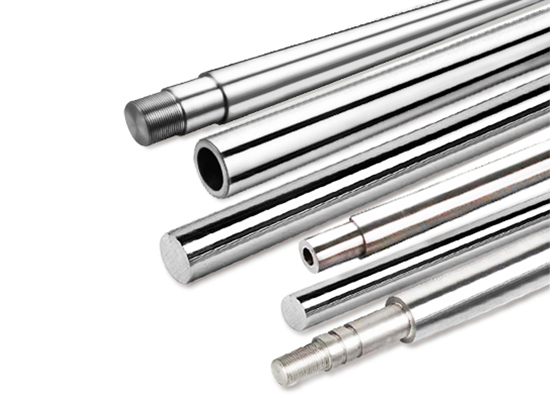
And the driving force is the compressed air inside the cylinder barrel(tube). The compressibility of air, friction, leakage, pressure drops in the piping, and other factors all contribute to the difference between the theoretical and actual force of a cylinder.
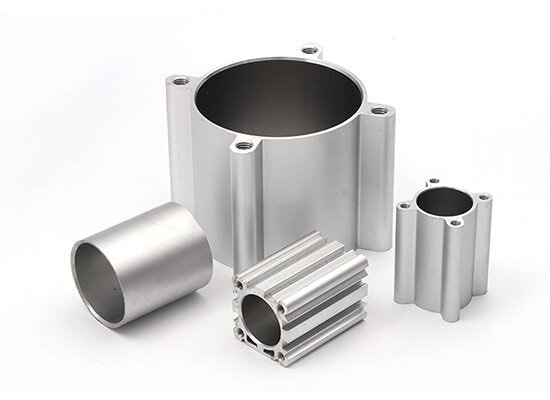
Thus, the key parameters required for the calculation are the piston rod and the cylinder barrel.To choose the right pneumatic cylinder bore, you need to perform air cylinder force calculation with some vital parameters.Cylinder actuator thrust includes extension force and return force, which are different but closely related.
First of all, it is the key to select the cylinder to clarify the actual load(the actual force generated by the cylinder).The load force pushed or carried by the cylinder in practical applications will be affected by factors including workpiece weight, friction force, acceleration demand etc., is smaller than the theoretical output force.By accurately calculating the load size and combining the force formula of the cylinder, we can reversely deduce the appropriate cylinder bore range, and then select suitable cylinder within this range.
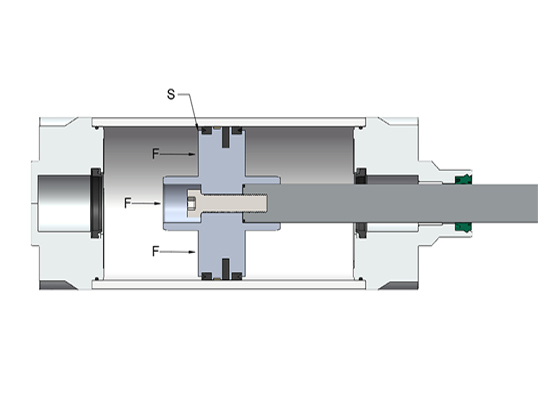
The output force of the cylinder is only a theoretical value, which is related to three main parameters: working pressure P, theoretical force F0, and cylinder cross-sectional area S.Among them, the Working pressure P is generally between 0.4MPa and 0.8MPa, the Theoretical force F0 can be reversed according to actual needs, and the Sectional area of cylinder S can be obtained according to the cylinder bore using:S = πr2. After obtaining the main parameters, we can solve the problem by using the formula F = P x S.
Next, we use an example to understand the actual ouyput force calculation process.
◆ Know Your Cylinder's Working Pressure:
The pressure inside the cylinder plays a significant role in determining the force. Make sure you have the accurate working pressure (P) of your pneumatic air cylinder.
◆ Measure Your Piston's Diameter:
Measure the piston diameter (D) to calculate the area upon which the pressure will act. The force generated is directly proportional to the piston area.
◆ Calculate the Piston’s Area
Use the formula to calculate the piston area(s).
S=πD2/4
Try to calculate the actual thrust of a cylinder with a cylinder diameter of 50mm (π=3.14)
The Working pressure is generally taken as
P = 0.6MPa ≈ 6kgf/cm2
Sectional area of cylinder
S = πr2 = 3.14 x 25 x 25 = 1962.5mm2 = 19.625cm2
Then the Theoretical force
F0 = P x S = 6 x 19.625 = 117.75kgf
Due to factors such as energy loss and margin, the theoretical force cannot be fully converted into the actual force, so we multiply the theoretical force by a coefficient A less than 1 to obtain the final actual force
A = 0.8
Then the actual force
F = F0 x A = 117.75 x 0.8 = 94.2kgf
Through the above calculation, we can get the actual force of the 50mm cylinder is about 94.2kgf, and we also understand the calculation method of the cylinder force.
However, in practical applications, we often need to select the cylinder bore when the actual force is known. Can this be achieved by reverse calculation?
Of course, this is also possible. In fact, we only need to know two of the three main parameters to calculate the third main parameter.
Similarly, let's use an example to understand the calculation method of this situation.
If we now know that in actual work, the cylinder needs to generate at least 170kg of force.
Then we know
F ≥ 170kgf
Then the Theoretical force is
F0 = F / A = 170 / 0.8 = 212.5kgf
The Working pressure is
P = 0.6Mpa ≈ 6kgf/cm2
The required Sectional area of cylinder
S = F0 / P = 212.5 / 6 ≈ 35.4cm2
From S = πr2 ,we can know the cylinder barrel radius is
R=√s/√π=33.58mm
Then the cylinder bore is
d = 2r = 33.58 x 2 = 71.16mm
The cylinder model is not continuous. Generally, the cylinder bore is 25mm, 32mm, 40mm, 50mm, 63mm, 80mm, 100mm, etc. Therefore, a cylinder with a cylinder bore of 80mm or more should be selected.
Generally, larger diameter cylinders operate slower and more expensive due to inertia loads and friction losses. So there is no need to select the cylinder with too large cylinder diameter to meet the demand. Therefore, in the above example, a cylinder with a bore of 80mm is generally selected.
However, in some situations, due to various factors, such as material restrictions, environmental protection requirements, gas source stability, system adaptability, etc., a cylinder with a larger cylinder diameter may also be selected.
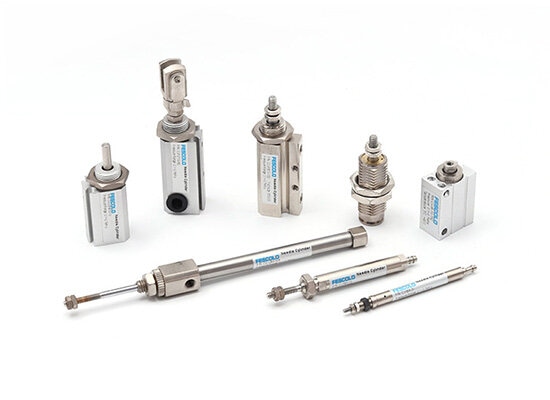
Sometimes, due to installation conditions, speed requirements, and other limitations, it is also possible to choose cylinders with smaller diameters by increasing the supply pressure, or to choose special types of cylinders such as compact cylinders, mini pneumatic cylinders or other piston air cylinder.
After understood the thrust calculation method of the cylinder, we can inversely deduce:
d=√4F0/√p*π
Then, the cylinder diameter can be quickly calculated with this formula.
Let's walk through an example where you want to calculate the force of a single-acting pneumatic cylinder with a piston diameter of 50 mm and a working pressure of 400,000 Pa.
◆ Select "Single-acting" Cylinder Type: Choose the cylinder type (single-acting) in the calculator.
◆ Input Cylinder Pressure (P): Enter the working pressure of 400,000 Pa (Pascal) in the "Cylinder pressure" field.
◆ Input Piston Diameter (D): Enter the piston diameter of 50 mm in the appropriate box.
◆ Calculate the Force: After entering the necessary data, the air cylinder force calculator will output a calculated force of 785.4 Newtons. This is the maximum force that the cylinder can exert under these conditions.
Pneumatic cylinders use compressed air to generate force. The force is a result of the pressure applied to the piston's surface area. Pneumatic force is typically faster and more flexible, making it an ideal for high-speed applications and tasks requiring quick response times. However, pneumatic force may lack precision in force control compared to electromechanical force.
Electromechanical systems use motors, gears, and actuators to produce force. These systems offer more precise control over force and movement, making them suitable for applications where accuracy and steady force are crucial. Electromechanical systems, however, tend to be slower and can be more expensive due to the complexity of components.
Pneumatic systems are generally faster and more flexible, ideal for tasks needing rapid force generation.
Electromechanical systems are more precise and can maintain constant force but may be slower in operation.
Cylinders play a vital role in modern industry and machinery. You can also visit our Blog page, where we provide a series of articles, pictures, videos and other resources to help you better understand the work principles, characteristics, applications and other aspects of pneumatic cylinders and components.
The stroke of a pneumatic cylinder is the distance the piston travels inside the cylinder barrel from one extreme position to the other. This movement is what allows the cylinder to perform mechanical work.
The bore is the internal diameter of the cylinder barrel. It is essential in calculating the cylinder's force, as it directly affects the piston's area.
The force that a pneumatic cylinder can lift is primarily determined by its piston diameter, the pressure applied to it, and the type of cylinder (single-acting or double-acting). Greater cylinder force demands higher performance from the cushioning mechanism.
A pneumatic cylinder force calculator is an online tool used to quickly calculate the thrust or pulling force of a cylinder based on input parameters such as air pressure and cylinder diameter. It is useful for evaluating pneumatic system performance during the design and component selection process.

Whatsapp QR:

WeChat QR:

Tell us about your application requirements. Our engineers will review your project and provide practical feedback within 1–2 working days.

Fescolo is the specialized custom pneumatic cylinder brand operated by Ningbo Fokca Automation Co., Ltd.
Looking for standard pneumatic and automation components?
Visit Fokca
© 2026 Ningbo Fokca Automation Co., Ltd. All Rights Reserved. Sitemap