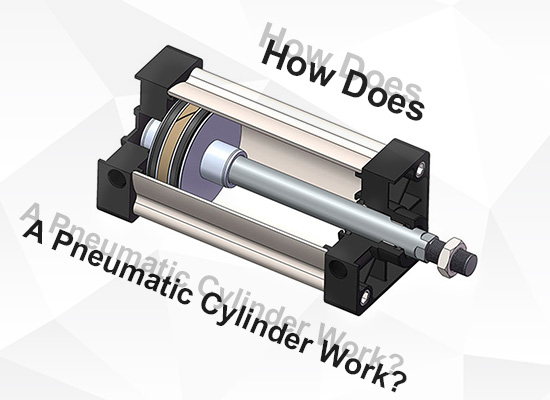
Nov 28, 2025
A pneumatic double cylinder combines two cylinders into a single assembly to deliver greater output force, longer stroke options, or more complex motion compared to a standard single cylinder.
A double-acting cylinder is an air operated actuator that can be driven by a pressurized medium in both forward and reverse directions. Unlike a single-acting cylinder, a double-acting cylinder does not rely on a spring or external force for return; instead, air or hydraulic oil acts on both sides of the piston to achieve the pushing and pulling actions.
In this cylinder's action, air or hydraulic oil enters one end of the cylinder through the air inlet/oil inlet, pushing the piston outward; when pressurized medium is introduced to the other end, the piston is forced to move in the opposite direction, achieving the return stroke. Both ends are sealed and designed with piston rods to ensure pressure-driven operation and efficiency.
The operation of a double-acting pneuamtic cylinder mainly consists of the following three stages.
Compressed air enters one side of the cylinder chamber through a control valve, pushing the piston along the cylinder axis. At the same time, the air in the opposite chamber is compressed or exhausted to provide space for the piston to move.
This stage is the actual cylinder action. Under the force of air pressure, the piston moves linearly along the cylinder, driving the piston rod to perform push or pull actions, thereby completing the required linear mechanical motion. The piston rod can bear loads, enabling the pushing, pulling, clamping, or positioning of objects.
The air in the chamber being pushed is exhausted through the outlet, releasing pressure, while compressed air enters the opposite chamber, causing the piston to move in the opposite direction and complete the reciprocating motion.
Definition:A guided cylinder is a cylinder integrated with a guiding mechanism on a standard cylinder, which prevents piston rod rotation and can withstand certain lateral loads.
Applications:It is suitable for applications requiring high stability and precise positioning, such as assembly, fixture actuation, and inspection equipment.
Precautions:Avoid exceeding the rated lateral load, and ensure proper alignment and sufficient rigidity during installation.
Definition:A rodless cylinder transmits motion through magnetic coupling or mechanical linkage, providing linear output without a piston rod.
Applications:Commonly used in long-stroke, space-constrained automated conveying and positioning systems.
Precautions:High installation precision is required; external guides are usually needed, and magnetic coupling types should avoid overload.
Definition:A rotary cylinder converts compressed air into angular rotational motion.
Applications:Suitable for workpiece rotation, sorting, and directional switching operations.
Precautions:Confirm the required rotation angle and output torque, avoid overload, and ensure proper buffering.
Definition:A mini cylinder is a compact pneumatic actuator with a small bore size.
Applications:Used in space-limited, light-load applications requiring precise pushing and positioning.
Precautions:Limited output force, sensitive to air source stability, and should avoid misalignment and vibration.
Visual Inspection
Regularly inspect the cylinder for damage, cracks, or leaks. Check the piston rod surface for smoothness, scratches, or rust; ensure mounting brackets and fasteners are secure; and lubricate hinges supporting cylinder movement.
Seal Inspection
Regularly lubricate all cylinder components. Inspect O-rings and end cap seals for aging or wear, and replace them promptly.
Air Source Purification
Maintain clean compressed air, efficiently removing moisture and impurities to prevent internal cylinder corrosion or blockage. Check air pipe joints for tightness to prevent leaks from affecting cylinder operation. Ensure solenoid valves, quick-release valves, mufflers, and other pneumatic components are functioning correctly.
Guide Rod Installation
Install guide rods on the piston rod to prevent overload or lateral forces from acting on it, thus preventing guide failure or seal damage.
Cushioning Mechanism Configuration
In high-frequency, high-speed, or long-stroke applications, regularly check the cushioning device and its effectiveness at the end of the cylinder stroke.
Piston position detection
Use compliant sensors to detect piston position limits. You can choose cylinder types with built-in magnetic pistons to increase the detection effect.
(9016)
 Pneumatic Clamping Module Design in Packaging Machinery
 Pneumatic Fittings Replacement Cycle: How Often Should You Change Pneumatic Fittings
 Pneumatic Pusher Module Design in Pneumatic Packaging Machines
 Vacuum Filter and Response Time: Does Filtration Slow Down Vacuum Systems
 Metal Seated Pneumatic Ball Valve: When Is Metal Sealing Required?

Whatsapp QR:

WeChat QR:

Tell us about your application requirements. Our engineers will review your project and provide practical feedback within 1–2 working days.

Fescolo is the specialized custom pneumatic cylinder brand operated by Ningbo Fokca Automation Co., Ltd.
Looking for standard pneumatic and automation components?
Visit Fokca
© 2026 Ningbo Fokca Automation Co., Ltd. All Rights Reserved. Sitemap