Dec 04, 2025
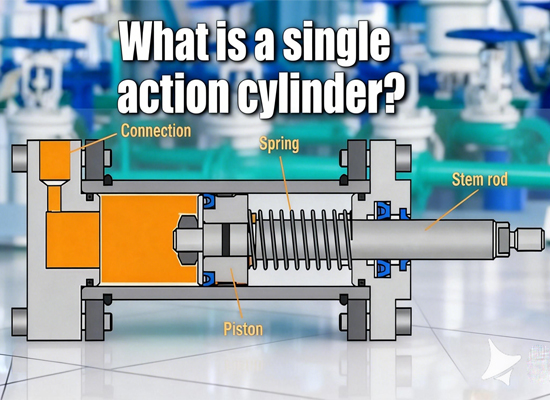
A single-acting pneumatic cylinder uses compressed air to produce force in one direction only. The return movement is produced by an internal spring, gravity, or another external force. This is the key difference from a double-acting cylinder, which uses compressed air to control motion in both directions.
Single-acting cylinders are commonly used for simple machine functions such as clamping, ejecting, pressing, lifting a light mechanism, opening or closing a device, or returning an actuator to a defined position. Their main advantage is not that they are universally "better" or "safer," but that they can simplify the pneumatic circuit when only one powered direction is required.
The operating cycle can be understood in two stages: a powered stroke and a return stroke.
When the directional valve connects the cylinder port to the compressed-air supply, pressure builds on the effective piston area. The resulting pneumatic force moves the piston and piston rod in the powered direction. In a spring-return design, part of that force must also overcome the spring force and internal friction.
The theoretical pneumatic force is based on pressure and effective area:
F = P x A
Actual available force is lower than the simple theoretical value because seals, guides, spring force, pressure losses, and other mechanical effects consume part of the output. For this reason, cylinder selection should include an appropriate design margin rather than matching theoretical force exactly to the load.
When the valve switches the cylinder port from supply to exhaust, pressure in the working chamber falls. The spring, gravity, or external mechanism then moves the piston back toward its starting position while the remaining air leaves through the same cylinder port and valve path.
In a spring-return cylinder, return speed and return force depend on the spring characteristics, moving mass, friction, orientation, exhaust restriction, and the mechanism connected to the rod. The return stroke is therefore not simply the powered stroke in reverse.
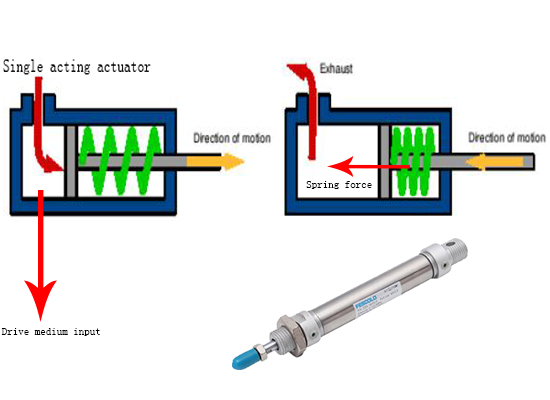
Many single-acting pneumatic cylinders use an internal spring, but “single-acting” describes how pressure acts on the actuator, not a requirement that every design contain a spring. Some applications use gravity, a counterweight, a mechanical linkage, or the external load to provide the return movement.
Single-acting cylinders can also be arranged so that air pressure extends the rod and the spring retracts it, or so that air pressure retracts the rod and the spring extends it. The correct arrangement depends on the machine function and the desired unpressurized position.
The basic pneumatic force still comes from pressure acting on an effective area, but the useful output must be considered together with the return mechanism. In a spring-return design, spring force changes as the spring compresses or extends, so the net force available to the external load can change through the stroke.
For a spring-return design, a useful simplified relationship is:
Net available force ≈ (Pressure × Effective piston area) − Spring force − Friction
Because spring force usually changes as the spring is compressed or extended, the available net force can vary through the stroke. Selection should therefore check the most demanding point of travel rather than relying on a single theoretical P × A value.
Factor | Effect on operation |
Operating pressure | Higher pressure increases theoretical pneumatic force within the cylinder’s rated limits. |
Bore / effective piston area | A larger effective area produces more pneumatic force at the same pressure. |
Spring force | Reduces net force in the air-powered direction when the cylinder works against the spring. |
Friction and seals | Consume part of the theoretical output and influence low-speed behavior. |
Stroke | Determines travel distance and, in spring-return designs, may influence spring characteristics and packaging. |
Load orientation | Gravity can assist or oppose motion depending on installation direction. |
For a detailed bore and force calculation, see Pneumatic Air Cylinder Force Calculation.
Single-acting | Double-acting | |
Powered directions | One | Two |
Typical ports | Usually one working port | Usually two working ports |
Return method | Spring, gravity, or external force | Compressed air |
Circuit | Can be simpler for one-direction work | Better control of both extension and retraction |
Force behavior | Return mechanism affects net output | Pressure controls both directions; rod side has less effective area in a single-rod cylinder |
Typical fit | Simple one-direction actions and defined return functions | General automation requiring controlled motion in both directions |
The choice is application-dependent. A single-acting cylinder can reduce valve and air-line complexity, while a double-acting cylinder is usually more flexible when the machine requires controlled force, speed, or timing in both directions.
For comparable operating conditions, a single-acting cylinder consumes compressed air only for the powered stroke, so it can use less air per cycle than a double-acting cylinder that is pressurized for both directions. The actual system-level savings depend on bore, stroke, pressure, cycle rate, dead volume, valve and tubing volume, leakage, and how the machine operates.
This means "lower air consumption" can be a real advantage, but it should not be treated as a fixed percentage or as the only selection criterion.
A spring-return single-acting cylinder may move toward its spring-defined position when air pressure is removed. However, that behavior should not automatically be described as a safe state. Whether the resulting movement is safe depends on the machine, load, orientation, stored energy, guarding, control architecture, and risk assessment.
For example, returning a clamp, gate, or vertical load after loss of pressure can have very different consequences. The required fail position should therefore be defined at the machine level before the actuator is selected.
• Clamping fixtures where pneumatic force is required in one direction and the mechanism can return mechanically.
• Ejection and part-release mechanisms in assembly or packaging equipment.
• Light pressing or positioning actions where the return load is small and predictable.
• Doors, gates, latches, or locking mechanisms where a defined unpressurized position is part of the machine design.
• Simple automation functions where reducing valves, tubing, and control complexity is valuable.
Application suitability still depends on required force, stroke, cycle rate, return force, orientation, installation space, and environmental conditions. A familiar application name alone is not enough to select the cylinder.
In many spring-return designs, the spring side must breathe as the piston moves. If a breather, vent, or exhaust path is blocked or exposed to heavy contamination, return behavior can become slow or unreliable. The exact construction varies by cylinder, so installation and maintenance should follow the manufacturer’s instructions for the specific design.
Start with the machine function rather than the cylinder catalogue. Define which direction must be powered, what should happen when pressure is removed, and how much force is required at the most demanding point in the stroke.
Check | What to define |
Force | Required load force, operating pressure, friction, and design margin. |
Return behavior | Spring return, spring extend, gravity return, or external mechanical return. |
Stroke | Required travel plus installation and mechanism clearances. |
Speed and cycle rate | Valve flow, tubing, exhaust restriction, moving mass, and return mechanism. |
Mounting and alignment | Load should be transferred without unnecessary side load on the piston rod. |
Environment | Temperature, contamination, washdown, corrosion, and material/seal compatibility. |
Failure state | What the mechanism should do after loss of air or electrical power. |
Standard single-acting cylinders are efficient when the required bore, stroke, mounting, spring behavior, and installation envelope already match a catalogue design. OEM equipment can require something different: a non-standard stroke, restricted space, unusual mounting points, a specific unpressurized position, special materials, or a return force that must match the mechanism.
For those projects, cylinder design should be based on the application conditions rather than changing the machine simply to fit an available catalogue model. Fescolo uses this application-first approach when reviewing custom pneumatic cylinder requirements for OEM equipment.
No. An internal spring is common, but gravity or an external mechanism can also provide the return movement.
Yes. Some single-acting designs use air pressure for retraction and a spring for extension. “Single-acting” means pressure powers one direction, not that the powered direction must always be extension.
P x A gives theoretical pneumatic force. Internal friction, pressure losses, and, in spring-return designs, spring force reduce the net force available to the external load.
A double-acting cylinder is usually the better fit when the machine needs controlled pneumatic force and motion in both directions, longer or more flexible strokes, or return behavior that should not depend on a spring or external load.
• How Does a Pneumatic Cylinder Work?
• Pneumatic Air Cylinder Force Calculation
 Pneumatic Clamping Module Design in Packaging Machinery
 Pneumatic Fittings Replacement Cycle: How Often Should You Change Pneumatic Fittings
 Pneumatic Pusher Module Design in Pneumatic Packaging Machines
 Vacuum Filter and Response Time: Does Filtration Slow Down Vacuum Systems
 Metal Seated Pneumatic Ball Valve: When Is Metal Sealing Required?

Whatsapp QR:

WeChat QR:

Tell us about your application requirements. Our engineers will review your project and provide practical feedback within 1–2 working days.

Fescolo is the specialized custom pneumatic cylinder brand operated by Ningbo Fokca Automation Co., Ltd.
Looking for standard pneumatic and automation components?
Visit Fokca
© 2026 Ningbo Fokca Automation Co., Ltd. All Rights Reserved. Sitemap