Dec 23, 2025
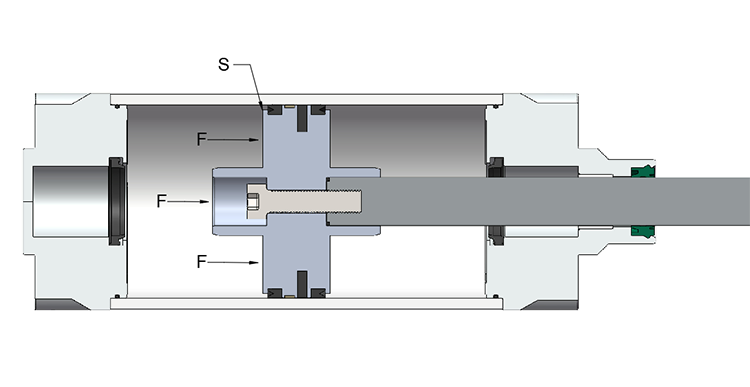
Bore and stroke have always been important parameters for consumers when selecting a cylinder and calculating its performance. The cylinder bore refers to the internal diameter of the cylinder barrel, which is the diameter along which the piston moves inside the cylinder. It directly determines the piston's effective area, thereby affecting the force the cylinder can generate for pushing or pulling. The cylinder stroke refers to the maximum distance the piston can travel from one end of the cylinder to the other.
Working Pressure Range
Push / Pull Force
Mounting Type
Piston Rod Diameter
Stroke Speed
Cushion mechanism
Temperature Range
The theoretical output force of a pneumatic cylinder is calculated as:
Output Force = Air Pressure × Effective Piston Area
Where:
Air pressure is the system working pressure
Effective piston area depends on the cylinder bore
At a fixed bore size, output force increases linearly with air pressure. However, pressure is often limited by system design, safety standards, and component ratings, making bore selection the primary method of force adjustment.
In practice, a cylinder's actual output force is lower than the theoretical value due to friction, resistance, pressure losses, and misalignment, so a safety margin should always be considered during selection.

The piston area increases with the square of the bore diameter. Even a small increase in bore can result in a significant increase in output force.
For example, under the same air pressure:
A 32 mm bore cylinder produces nearly twice the force of a 25 mm bore
A 63 mm bore cylinder produces approximately four times the force of a 32 mm bore
This demonstrates how sensitive output force is to bore changes.So, if you want to increase the cylinder's force, can you just increase the bore size?Increasing the cylinder bore is one way to increase its force, but factors such as air pressure, friction, load alignment, and supply stability must also be considered to ensure the actual output force meets requirements.
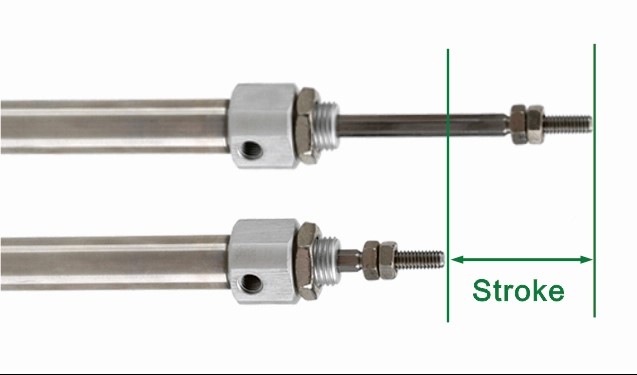
Stroke length does not directly change the theoretical output force, as force depends on pressure and piston area, not stroke.
In long-stroke applications, the effective output force can decrease due to higher friction along the extended sealing surface and pressure drops in the air path.
Moreover,longer cylinder strokes can reduce stability and positional accuracy due to bending and side loads, and also increase movement time, lowering cycle frequency unless airflow or speed is optimized.
Cylinder design involves trade-offs: large-bore, short-stroke cylinders provide high force over a short range, while small-bore, long-stroke cylinders offer longer travel with lower force; selecting the optimal cylinder requires balancing force, speed, space, and efficiency.
System Pressure Fluctuation
Seal Condition and Friction Loss
Installation Orientation
Load Characteristics
Cylinder Selection Considerations
As a pneumatic cylinder manufacturer, we specialize in supplying standard cylinder and customed cylinder solutions, including flexible customization of bore size and stroke to meet different force, space, and application requirements. Through practical projects, we help customers optimize performance, improve reliability, and adapt cylinders to demanding operating conditions.
In addition to cylinders, we also supply a complete range of pneumatic components, such as valves, air preparation units, tubing, and fittings, providing customers with a reliable one-stop pneumatic solution.If you need,you can visit our website or contact us directly!
Increasing the bore can increase the cylinder volume, thereby providing more air and fuel mixture, which typically increases the engine's torque and power, especially at low RPMs.
A larger bore means a larger piston area and cylinder volume, which increases airflow resistance and friction, leading to slower rotational speeds.
Using a smaller bore and higher pressure is feasible, but the engine design must be able to withstand a higher compression ratio, which helps improve efficiency and power.
The most effective bore size depends on your specific application needs. High-performance vehicles typically choose larger bores, while economy engines may opt for smaller bores to optimize fuel efficiency.
A larger bore increases the cylinder volume, requiring more air and fuel mixture, which raises the cost of air consumption, especially under high-load conditions.
(FK9016)
 Pneumatic Clamping Module Design in Packaging Machinery
 Pneumatic Fittings Replacement Cycle: How Often Should You Change Pneumatic Fittings
 Pneumatic Pusher Module Design in Pneumatic Packaging Machines
 Vacuum Filter and Response Time: Does Filtration Slow Down Vacuum Systems
 Metal Seated Pneumatic Ball Valve: When Is Metal Sealing Required?

Whatsapp QR:

WeChat QR:

Tell us about your application requirements. Our engineers will review your project and provide practical feedback within 1–2 working days.

Fescolo is the specialized custom pneumatic cylinder brand operated by Ningbo Fokca Automation Co., Ltd.
Looking for standard pneumatic and automation components?
Visit Fokca
© 2026 Ningbo Fokca Automation Co., Ltd. All Rights Reserved. Sitemap