Dec 04, 2025

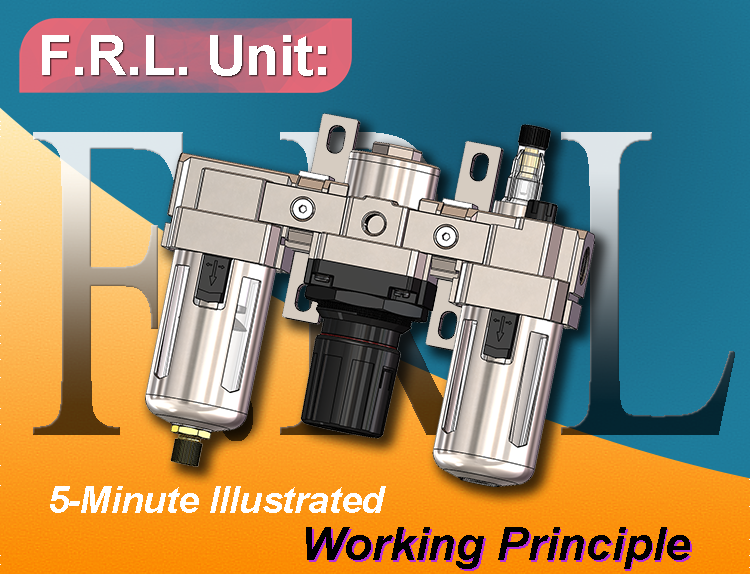
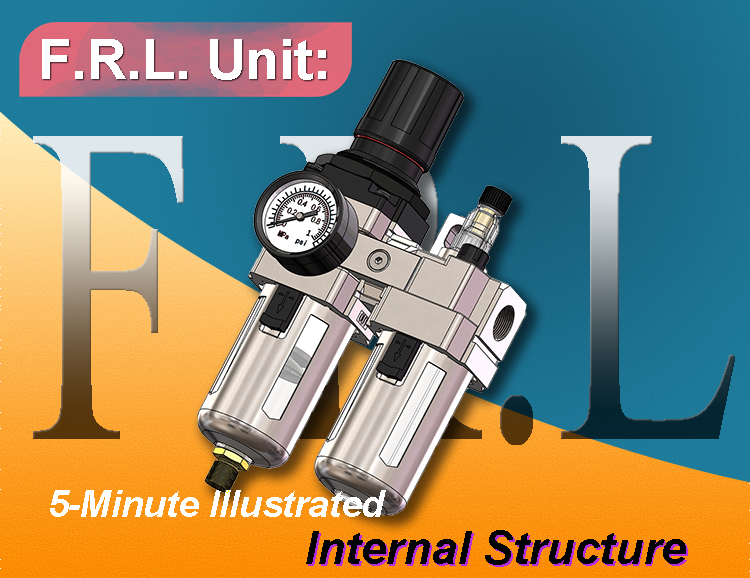
In the previous article "FRL: A 5-Minute Illustrated Guide to Its Internal Structure", we disassembled the various parts of the pneumatic F.R.L. unit (Filter, Regulator, Lubricator), addressing the question of what does frl mean—much like identifying all the gears and screws of a precision instrument.
Now, it’s time to tackle the question of "why"—how frl unit work, and through what mechanisms are these functions achieved? Let’s now bring these parts together in motion and delve into their operating principles.
Air Filter
The name F.R.L. itself clearly indicates the sequence of treatment. High-pressure air enters through the inlet port, flows first into the air filter body, and is directed downward through the guide vanes. These vanes feature a special helical centrifugal design that causes the air to rotate rapidly along the inner wall of the filter bowl, creating a strong vortex.
During this process, the system utilizes the principle of centrifugal separation to effectively remove impurities with higher specific gravity, such as liquid water, oil droplets, and larger solid particles. Driven by centrifugal force, these impurities are thrown toward the bowl wall and eventually collect at the bottom. This step removes most solid and liquid contaminants.
Subsequently, the compressed air is pushed through the filter element under pressure. The filter element is typically made of sintered fiber or porous material, with surfaces covered in micron-level pores that trap and adsorb finer solid particles and mist-like oil-water mixtures, achieving secondary purification of the air.
It is important to note that the liquid accumulated at the bottom of the bowl must be periodically drained via the drain valve; otherwise, filtration efficiency will be severely compromised.
At this point, the air purification step is complete, and clean air proceeds to the pressure regulator for pressure adjustment.
Air Regulator
After entering the pressure regulator, the compressed air is initially blocked by the sealing pair between the valve core and the valve seat. When the adjustment knob is pulled up and turned clockwise, the main pressure-adjusting spring is compressed, exerting a downward force on the diaphragm. The diaphragm then drives the valve core downward, separating it from the valve seat and allowing airflow to pass through the valve seat to the outlet.
Despite its simple structure, the pressure regulator possesses a key capability: leveraging the principle of force balance to self-adjust and maintain a stable outlet pressure, unaffected by fluctuations in flow rate.
Its dynamic pressure-stabilizing process is as follows (assuming a set pressure of 0.6 MPa):

When downstream air consumption increases: The outlet pressure drops, transmitting through the connecting small port to the chamber below the diaphragm. At this point, the air pressure force is insufficient to balance the spring force. The spring pushes the diaphragm and valve core downward, increasing the valve opening and restoring the pressure to 0.6 MPa.
When downstream air consumption decreases: The outlet pressure rises, increasing the air pressure below the diaphragm. This pushes the diaphragm upward to compress the spring, allowing excess air to escape through the relief port on the diaphragm, thereby reducing the pressure to the set value.
Air Lubricator
The pressure-stabilized airflow then enters the oil bowl of the lubricator, forcing lubricating oil up the oil tube into the sight glass and eventually dripping into the Venturi inside the valve body. Here, users can adjust the cross-sectional area of the oil suction tube via the sight glass to precisely control the oil drip rate.
As airflow from the inlet passes through the Venturi (a channel narrow in the middle and wide at both ends), the Venturi effect causes the velocity to increase and the static pressure to drop at the narrow section. This pressure difference draws the dripping oil upward, where high-speed airflow shears and atomizes it into micron-sized fine oil droplets, forming a uniform oil mist. The oil mist is then carried by the airflow to downstream pneumatic components, providing effective lubrication.
Thus, the three components of the air preparation unit each perform their specialized functions while working in synergy, sequentially completing filtration, pressure regulation, and lubrication to ensure the safe and stable operation of the pneumatic system. We hope this article helps you move beyond understanding the component parts to grasp their working principles, enabling more effective application and maintenance of air preparation systems.
Fokca(Fescolo)is a professional pneumatic cylinder manufacturer and supplier. As a leading Chinese supplier in this field, we specialize in providing high-quality, precision-engineered cylinders designed for a variety of applications.
As a manufacturer, we guarantee quality from raw materials by selecting premium aluminum/zinc alloys. Each valve body undergoes leak-proof die-casting, fully automated precision machining with strict tolerance control, surface treatment, and multiple automated quality inspections including pressure and airtightness tests to ensure every product meets standards.
Please feel free to visit our air treatment unit product page for more information. Additionally, you can explore our Blog, where we provide a range of resources including videos, images, articles, and drawings to help you better understand pneumatic products.
You May Interest In

Get a free sample

FOKCA ©1998-2025 Fescolo Pneumatic All Rights Reserved Sitemap