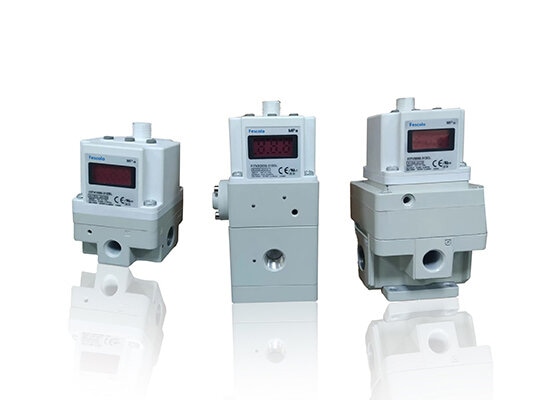
Digital Pressure Regulator
Electronic digital pressure regulator, also known as proportional pressure regulator, adjusts the cross-sectional area of the regulator core according to the size of the control signal, so as to achieve the technological goals and requirements of adjusting the pressure.
The electronic pressure regulator controls the gas pressure through electrical signals, which can realize the continuous and stepless adjustment of the gas pressure, and can realize remote control and program control,
especially suitable for the work occasions that require continuous or stepless adjustment of the gas pressure.
What is a digital pressure regulator?
A pressure regulator digital is a type of regulator valve type, also known as digital pressure controller. Its function is to adjust and control the pressure of gases or liquids in a precise and programmable manner.
Digital regulator valves are typically equipped with sensors, a microprocessor, and a display screen, allowing real-time pressure monitoring and precise adjustment and widely applicable in industries such as pneumatics, laboratory and research, industrial automation, and medical and analytical instruments.
Advantages of digital pressure regulator compared with other regulator valves
The advantages of the digital pressure regulator compared to the traditional mechanical pressure regulator are revolutionary. It represents not merely a change in adjustment method, but a leap from a "tool" to an "intelligent device."
◆ High-Precision Control:By using a closed-loop control system, advanced control algorithms, and high-resolution electronic components, it achieves precise regulation. The high-resolution DAC can convert digital signals into fine control actions.
◆ Digital Input/Output:Due to the built-in electronic control system,can be controlled via interfaces such as PLC, Modbus, RS-485, or 0–10V.
◆ Remote Control:Allows remote pressure adjustment through software or cloud platforms.
◆ Fast Response:Responds faster than mechanical regulators, suitable for dynamic adjustments.
Working Principle
A digital pressure regulator typically consists of the following components:
Electronic Controller : The core control unit that receives external setpoints and performs the regulation.
Pressure Sensor: Monitors the current pressure in real time.
Proportional Solenoid Valve / Servo Valve: Adjusts the output pressure based on signals from the controller.
Display Interface: A digital screen that shows both the setpoint and the actual pressure.
Industry Applications of digital pressure regulator
The pressure regulator digital is most needed in the following Regarding digitalization application scenarios.
◆ Automated production lines
◆ Medical equipment
◆ 3D printers
◆ Testing equipment and laboratory instruments
◆ Semiconductor manufacturing
◆ Aerospace systems